Product handling
Shape, friction, fragility and spacing determine whether manual loading, lugged infeed or automatic feeding is appropriate.

A versatile pillow-pack platform with PLC control, print registration and configurable feeding for discrete products and controlled groups.
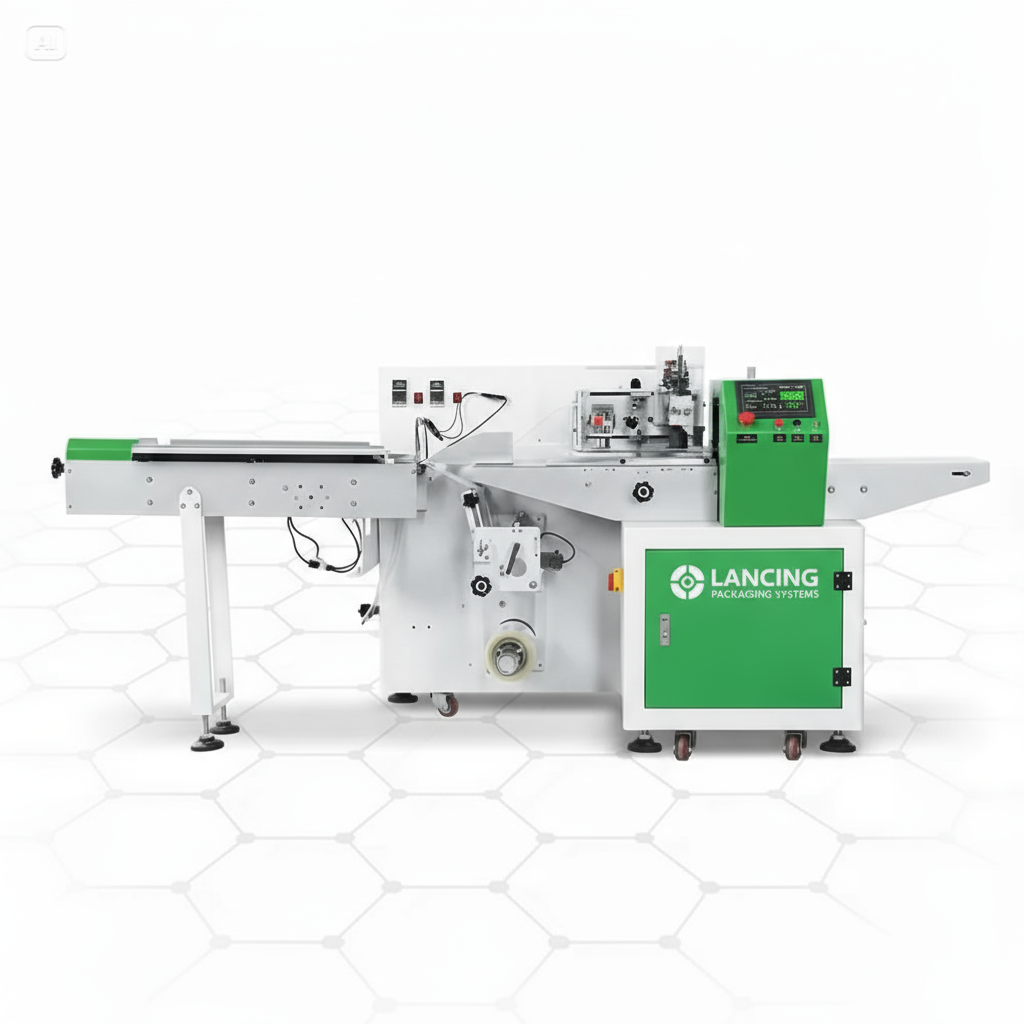
Products travel horizontally through the film former while the machine creates the longitudinal seal and separates each pack with transverse sealing jaws.
The LUZB350X is listed for a wide range of regular products—from biscuits and snack bars to soap, cosmetic kits, sponges, filters and small components. Its PLC and touchscreen interface coordinate film feed, product registration, heat control and cut timing.

Use these published values for early-stage screening. The formal machine proposal should confirm all limits against your product and film.
| Power supply | 110 / 220 / 380 V, 50 / 60 Hz |
|---|---|
| Installed power | 2.4 kW |
| Reference speed | 30–120 bags per minute |
| Maximum film width | 350 mm |
| Maximum film-roll diameter | 320 mm |
| Bag length | 90–6000 mm |
| Bag width | 30–160 mm |
| Maximum product height | ≤55 mm |
| Seal arrangement | Middle longitudinal seal with transverse end seals |
| Listed materials | OPP, OPP/CPP, KOP/CPP, aluminium film and bubble wrap |
| Approximate dimensions | 3836 × 890 × 1079 mm |
| Approximate machine weight | 350 kg |
Reference figures are a starting point. Final speed, electrical supply, guarding and film suitability will be confirmed against your product, film and production-line requirements.
The wrapper is only one part of a stable packaging process.
Shape, friction, fragility and spacing determine whether manual loading, lugged infeed or automatic feeding is appropriate.
Film thickness, sealant layer, stiffness, coefficient of friction and print repeat influence forming and jaw settings.
Upstream availability, queue management, reject signals and downstream capacity determine sustained output.
Change parts and product-handling design are selected around the intended format range.

The published machine data range is 30–160 mm bag width using film up to 350 mm wide. Product depth, film structure and the required seal geometry must also be checked.
The listed controls include photoelectric registration for printed-film mark tracking. The actual print repeat and eye-mark specification should be supplied for engineering review.
Coding or printing can be integrated subject to print area, film travel, code type and line-control requirements. Define whether the code is applied before or after the fin seal is formed.
No. It is the upper end of the published machine data range. Sustainable output varies with pack length, product stability, feeding, film and sealing dwell time.
The published speed is an early screening range. A sustainable rate can only be confirmed against the actual product, bag length, film, sealing window, infeed arrangement and downstream capacity.
Each pack occupies a repeat length made up of the product, clearance and end-seal allowance. Longer packs or wider seal dwell requirements reduce the number of jaw cycles available in a minute.
The wrapper cannot maintain good output if products arrive late, doubled, rotated or too close together. The infeed concept should create a predictable pitch and define how missing or misplaced products are handled.
The sealant must close reliably at the selected jaw speed. Temperature, pressure and dwell time are linked, while film friction and stiffness affect tracking through the former and fin-seal assembly.
The photoelectric sensor reads a registration mark so the machine can correct cut position. Mark contrast, location, repeat accuracy, web tension and unwind direction all affect reliable control.
Product, crumbs, loose parts or trapped film folds in the end-seal area can cause weak seals, poor cuts or jaw contact. Guides and timing must keep the sealing window clear.
Coding, inspection, checkweighing, metal detection, accumulation and case packing must accept the required rate. A downstream stop strategy should prevent product and packs building up at the wrapper.
A useful trial uses representative materials and written acceptance criteria. It should show whether the machine can create an acceptable pack repeatedly under conditions that resemble production.
| Trial item | Information or material | Acceptance evidence |
|---|---|---|
| Product envelope | Minimum, nominal and maximum length, width, height and weight, plus difficult production samples. | Controlled transfer through guides and former without damage, jams or loss of orientation. |
| Pitch and infeed | Required product spacing, arrival pattern, loading method and any groups or multipacks. | Stable placement between end seals and a defined response to missing or misplaced product. |
| Film reel | Production construction, width, thickness, core, diameter, unwind direction, print repeat and eye mark. | Stable web tracking, registration and reel fit without unacceptable film waste. |
| Seal window | Film supplier guidance and a range of temperature, pressure and line-speed settings. | Consistent longitudinal and end seals without channel leaks, burn-through, wrinkles or product contamination. |
| Pack appearance | Approved sample or drawing with cut position, seal widths, fin location, code and print alignment. | Finished packs stay within the agreed visual and dimensional tolerances. |
| Sustained output | Defined good packs per minute, test duration and permitted stops or rejects. | Recorded good output and reject reasons over the agreed run, not only a brief maximum-speed demonstration. |
This supplied footage shows a horizontal flow-wrapping machine operating with products travelling through the wrapping and sealing process. Use it as an overview; the project trial should use your own product and production film.
Product pitch is set by the product length, required clearance, end-seal width and the timing needed to keep the product out of the crimp jaws. The infeed must present every product at that pitch or provide a controlled recovery method.
A photoelectric sensor detects a contrasting mark printed once per pack repeat. The control system uses that signal to correct film position so artwork and cut location remain aligned. Supply the mark size, colour contrast, location, repeat length and unwind orientation.
Gas flushing may be assessed as a project-specific option when the product, film barrier, gas supply and validation method are defined. It should not be assumed from the standard machine data, and any residual-oxygen or shelf-life target must be proven under agreed test conditions.
A successful demonstration is useful only when the conditions can be reproduced. Record the product, film, mechanical setup, control settings and accepted pack standard for every approved LUZB350X format.
| Format record | Why it matters | Evidence to retain |
|---|---|---|
| Product envelope | Minimum, nominal and maximum dimensions, weight, surface and difficult variants determine guide and former clearance. | Named sample set, photographs or drawing, plus the production condition used during the trial. |
| Infeed and product pitch | Guide positions, flights or belts and the release timing keep the product between the crimp jaws. | Recorded settings and a check of missing, doubled, late or rotated product behaviour. |
| Film and reel | Structure, width, thickness, unwind, print repeat and registration mark affect tracking and cut position. | Approved data sheet, reel identification, artwork reference and accepted finished pack. |
| Former and seal arrangement | The former, fin-seal path, end-seal width and jaw timing establish pack geometry and seal clearance. | Part identification, mechanical positions and the approved fin and end-seal appearance. |
| Operating window | Temperature, pressure where adjustable, speed and dwell-related settings must produce repeatable seals without damaging film or product. | Accepted settings range and the agreed visual or integrity checks at representative production conditions. |
| Registration, code and inspection | Print-to-cut correction, code trigger and any inspection or reject function depend on the same product tracking. | Artwork alignment, legible code samples, challenge-test result and reject confirmation. |
| Good-pack standard | Operators need a clear first-off decision after setup, reel change or stoppage. | Approved sample or drawing with dimensions, seal position, cut position and permitted appearance variation. |
| Changeover and restart | A format is not proven if it cannot be restored after parts and settings have changed. | Change-part list, safe sequence, settings record and accepted first-off packs after repeat setup. |
The LUZB350X wrapping cycle can be specified around the product, but the complete output depends on how product is released to the infeed and how accepted packs leave the machine. State the required automation boundary before the infeed and controls are finalised.
Define whether an operator, upstream process, feeder, timing conveyor, collator or robot creates the required orientation and pitch. Include the normal rate range and what happens to unsuitable product.
Confirm bag-length control, printed-film registration, sealing, cutting, coding and any product-presence or inspection checks. Each option should have a measurable test rather than a generic description.
Plan discharge, inspection, rejection and accumulation so warm seals and lightweight packs are not damaged. The downstream system must also signal blocked or unavailable states back to the wrapper.
The format recipe should identify the upstream and downstream conditions used to prove output. Use the flow-wrapper line integration guide to define signals, transfers, fault recovery and ownership around the machine.
Save the approved product range, infeed and pitch settings, film and reel reference, former and guide setup, bag length, sealing settings, registration parameters, code setup, inspection rules, accepted pack standard and change parts used on the final machine.
Compare a defined sample set with the approved pack or drawing. Check dimensions, product position, longitudinal and end seals, cut and artwork position, code, opening or presentation requirements and any agreed inspection result before routine production is released.
No. Automatic film feed, sealing and cutting do not by themselves define how product reaches the correct pitch. The quotation must state whether loading is manual or includes conveyors, timing, counting, collating, feeding or robotic presentation.
Treat it as a controlled format change. Review machine limits, run representative product and production film, establish the sealing and registration window, record accepted settings and repeat the agreed pack-quality and sustained-output checks.
The LUZB350X page states the verified published model range. The final project still needs an approved product path, production film, sealing method, loading boundary and acceptance test. General flow-wrapper architecture terms should not be assumed to be standard options on this model.
Decide whether products can be pushed and spaced consistently or whether an alternative support and feed concept needs investigation.
Review infeed methodsCompare conventional and inverted film paths, then confirm the actual longitudinal-seal position on the proposed machine.
Review film-path optionsUse the real film and pack geometry to compare rotary or longer-dwell jaw concepts where the application requires it.
Review jaw motionUse the trial, FAT and SAT guide to define product samples, film, good-pack criteria, sustained output and fault recovery before acceptance.
These guides explain the process variables behind product spacing, pack repeat, operating rate, atmosphere control and coding interfaces without treating a published range as a project guarantee.
See how the film tube, longitudinal seal, end seals and product movement form a finished pack.
How a horizontal flow wrapper worksRelate product dimensions, seal clearance, print repeat and crimp-jaw timing.
Product pitch and pack lengthReview gas flushing, coding, inspection and reject interfaces as project-specific functions.
The silent 5.6-second clip is a close view of orange rectangular products transferring through a clear film web towards the transverse sealing area. It is useful for understanding the product path, but it is not a complete line test or evidence for another product.
| Approximate point | Visible machine activity | What to verify in a product trial |
|---|---|---|
| Opening view | Products move from an upstream blue belt towards the wrapper infeed with a visible gap between items. | Stable orientation, safe transfer, product detection and the actual variation in pitch. |
| Middle view | Products travel within the clear film path while metal guides control the route towards sealing. | Film tracking, former fit, contact with the product and clearance around fragile or variable features. |
| Closing view | The wrapped product approaches the rotating transverse sealing and cutting area. | No product in the jaw zone, acceptable end seals, cut position and stable discharge after sealing. |
The video has no spoken narration. Final machine suitability and output must be confirmed using the selected product, production film and agreed acceptance method.
The LUZB350X is a horizontal flow wrapper, which is one form of horizontal form fill seal. It carries discrete products or controlled groups along an infeed, forms film around them and makes a longitudinal seam and transverse end seals. HFFS is a broader term, so the pack style and film path should still be stated in a quotation.
The published application list includes sachet multipacks, but suitability depends on the complete group dimensions, count, orientation, stability, film width, pack length and the collation or infeed system. A representative grouped-product trial is required before the configuration is confirmed.
No universal temperature can be specified for every film. Use the production film supplier’s data and qualify a stable range on the machine, considering pressure, dwell, speed, jaw condition, product clearance and the accepted seal test.
Not automatically. The wrapper can form and seal packs continuously while products are loaded manually or by a separate flighted, metered, collating or robotic infeed. The quotation should state the loading boundary and recovery logic explicitly.
Share your product, pack size, film and target output for a practical machine recommendation.